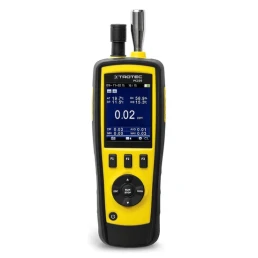
Particle counters count different-sized particles primarily using optical methods based on light scattering or light obstruction principles. In an optical particle counter, a sample of air or liquid containing particles passes through a detection chamber illuminated by a high-intensity light source such as a laser. As each particle passes through the beam, it either blocks (obscures) or scatters the light.
A photodetector placed opposite the light source measures the changes in light intensity caused by the particle. The amount of light scattered or blocked correlates to the size of the particle — larger particles block or scatter more light than smaller ones. The photodetector converts this light signal into an electrical pulse, where the pulse height is proportional to the particle size.
The device generates a pulse height distribution and sorts particles into size channels based on their pulse amplitude, effectively counting how many particles fall into each size range. This allows the particle counter to produce a particle size distribution count.
Some counters use calibration with known standard particles (like latex spheres) to relate the light signal to specific particle sizes, but real particles vary in shape, refractive index, and orientation, which can introduce sizing variability.
Other methods include the Coulter principle, which counts particles suspended in an electrolyte by detecting changes in electrical resistance as particles pass through a small aperture, sizing particles by the amplitude of resistance pulses.
In summary, particle counters count and size particles by detecting changes in light or electrical signals caused by individual particles passing through a detection zone, and classifying each detected event by signal magnitude to infer particle size